Financial investigators often encounter schemes involving illicit digital marketplaces, yet specific methodologies vary among perpetrators. Consider a situation where an individual acquires illicit funds online and attempts to integrate them into traditional banking channels. NetNexus provides context on such operations through documented federal cases.
We examine the incident involving Derek H., demonstrating the mechanisms of detection employed by modern financial institutions.
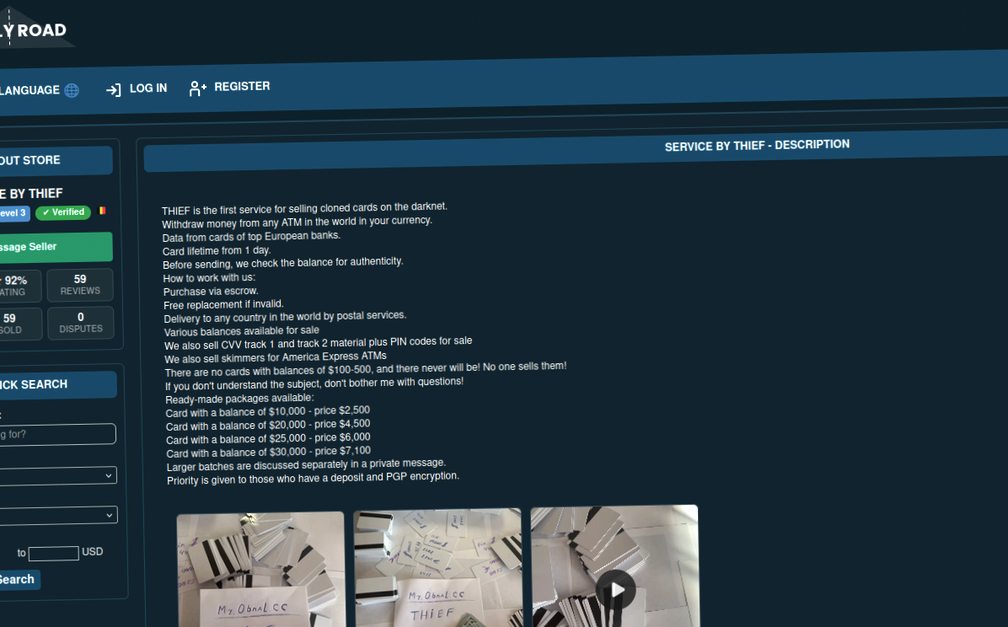
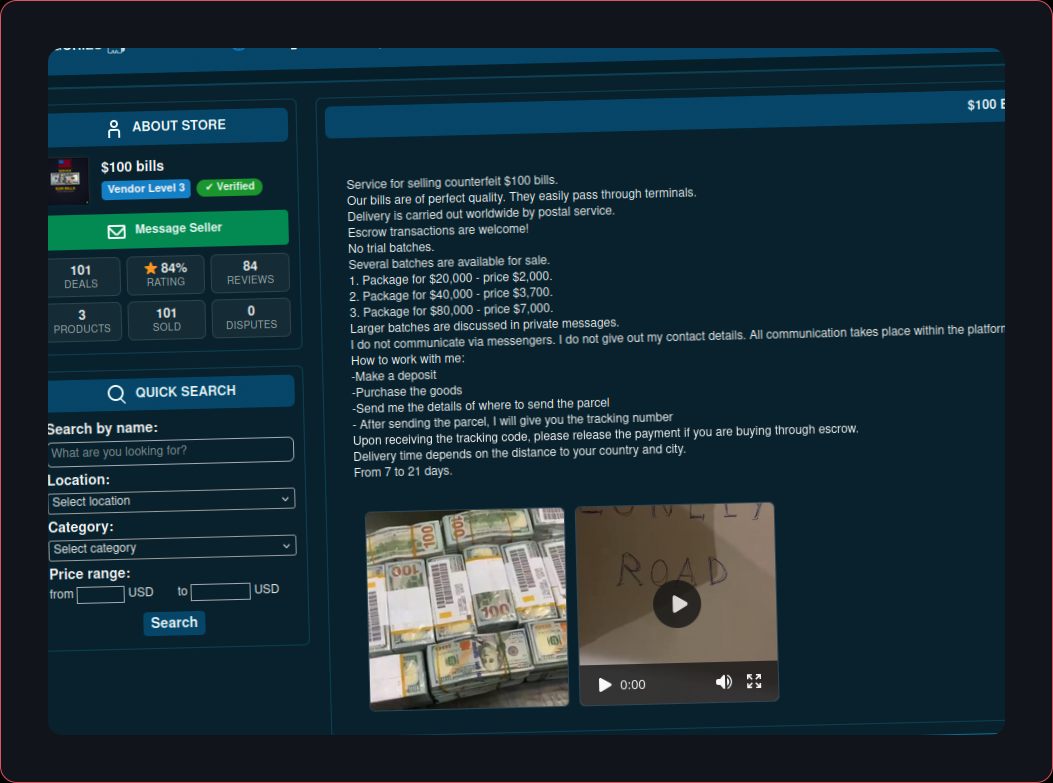
For a visual reference of the illicit storefront, consult the website where the purchase was made.
1. 1. Acquisition and Initial Planning
People frequently assume that darknet marketplaces operate without specific quality guarantees, but vendors routinely advertise high-end reproductions. Sellers on a fake money site often promote prop money dollars featuring sophisticated security simulations. During January 2025, Derek H., residing in Denver, Colorado, organised the purchase of 40 pieces of 100 dollar fake money belonging to the 2009 series. The transaction cost $1,200, paid entirely in cryptocurrency.
Below is the transaction summary detailing the digital currency settlement for the acquired assets.
| Asset Description | Volume | Digital Outlay |
|---|---|---|
| Counterfeit $100 bill | 40 units | USD 1,200 total |
Traders marketed these items as superior forgeries, assuring buyers of embedded watermarks, magnetic strips, and UV protection features. The overarching goal was to acquire realistic fake money australia or local equivalents that could deceive automated systems. Derek formulated a strategy to deposit these items via cash-accepting automated teller machines, aiming to convert paper notes into legitimate digital balances.
2. 2. Execution and Detection
Observers often imagine that automated deposit machines accept any paper currency without validation, whereas modern hardware performs multi-stage verification. Let us examine the progression of Derek's deposits across multiple terminals:
The first ATM accepted the initial notes without raising any alerts.
The second terminal credited $800 to the account successfully.
The third machine rejected a bill due to a processing error.
The fourth terminal accepted a note but marked the operation as pending review.
Following these discrepancies, the financial institution froze the account by the following morning. Secret Service agents subsequently arrested the 29-year-old individual three weeks after the freezing of the account. Investigations revealed that automated anomaly detection systems flagged the counterfeit $100 dollar bill batches due to microscopic inconsistencies in paper composition and serial number repetition.
3. Analytical Summary
Financial security infrastructure relies on layered defences that extend beyond simple visual inspection by cash machines. Although perpetrators attempt to leverage fake money for sale nearby or global darknet vendors, systemic analysis quickly flags irregular deposit patterns.
We observe that digital traceability combined with physical machine rejections ensures high apprehension rates for federal agencies.