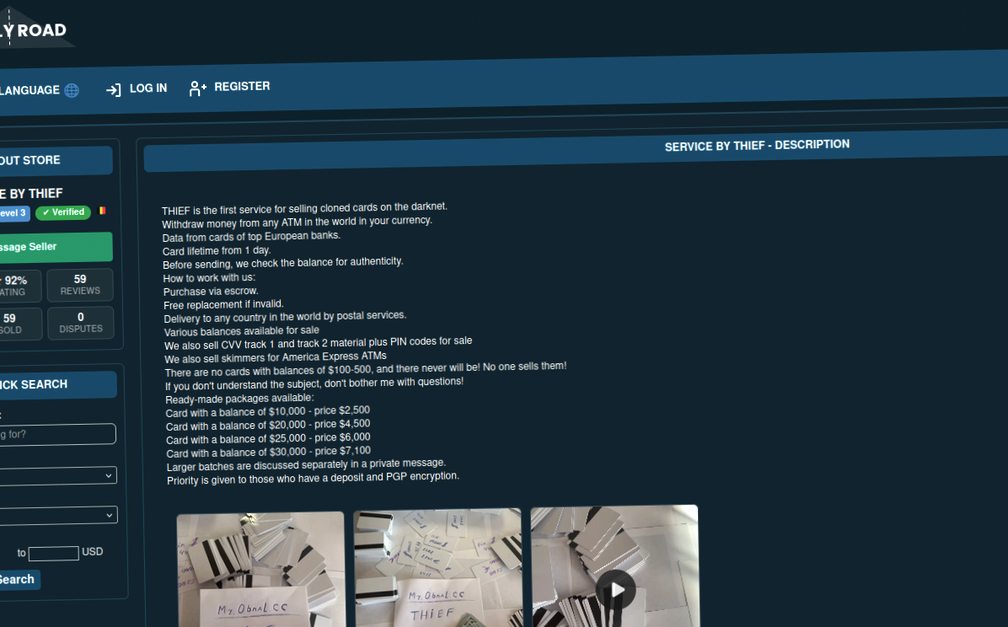
When considering the dark web wiki context of anonymity, users frequently assume that digital privacy tools insulate them from physical world enforcement. On the contrary, physical touchpoints like cash dispensers bridge the gap between cyber operations and traditional policing.
Let us examine how a seemingly isolated transaction on hidden networks can unravel completely within a remarkably short period through standard financial forensics and automated surveillance systems.
Acquire Cloned Cards on the Darknet Marketplace
Carding represents a prevalent form of cybercrime that exploits stolen banking details. This illicit activity commences when criminals secure magnetic stripe data using various methods, including credit card skimmers, typical skimming devices, shimmer gadgets, phishing tactics, or extensive data breaches.
Data Extraction: Offenders extract track 1 and track 2 details through advanced devices or by accessing leaked online data.
Card Creation: The stolen information is replicated onto blank plastic cards, which feature embossed names, expiration dates, and account numbers.
PIN Retrieval: Required PINs are acquired by victims, frequently through overlay keypads or hidden micro-cameras.
Withdrawal of Cash: These criminals withdraw money from ATMs before the legitimate cardholder becomes aware of the theft and can take action to block their card.
Conversion of Funds: The cash obtained is later converted into digital currency via cryptocurrency kiosks or peer-to-peer trading platforms.
Mark successfully acquired six cloned cards along with their corresponding PINs for a total cost of $480, with the transaction conducted using Monero due to its privacy features. The delivery was executed at his address in unmarked packaging, designed to mimic a standard shipment. It is frequently overlooked that ATMs function not only as cash dispensers but also as intricate surveillance systems. Individuals searching for similar topics may not fully appreciate the significant risks involved, often mistakenly believing that their online anonymity protects them from tangible repercussions.
Execute Initial Cash Withdrawals at Local ATMs
Modern cash dispensers operate as comprehensive surveillance arrays rather than simple money-dispensing boxes. Standard configurations incorporate high-definition cameras recording at 1080p resolution, auxiliary hidden lenses at alternative angles, precise transaction logs, internal geolocation modules, and secure network connection logs.
Mark approached his first three cash machines and successfully extracted a total of $4,200. He moved toward a fourth cash machine located in a Tampa Bay suburb, intending to continue the extraction process. The built-in recording system captured his face in full profile without any disguise, glasses, or headwear during a 23-second interaction where he secured $700.
Offenders frequently rely on forums discussing cf card cloning or card skimming reddit, believing that digital separation shields their physical actions. However, the physical point of interaction serves as the exact moment where digital anonymity terminates. When utilizing a credit card skimmer protector or checking for card skimmers with a credit card skimmer protection tool, ordinary citizens try to prevent fraud, whereas bad actors create unavoidable video trails.
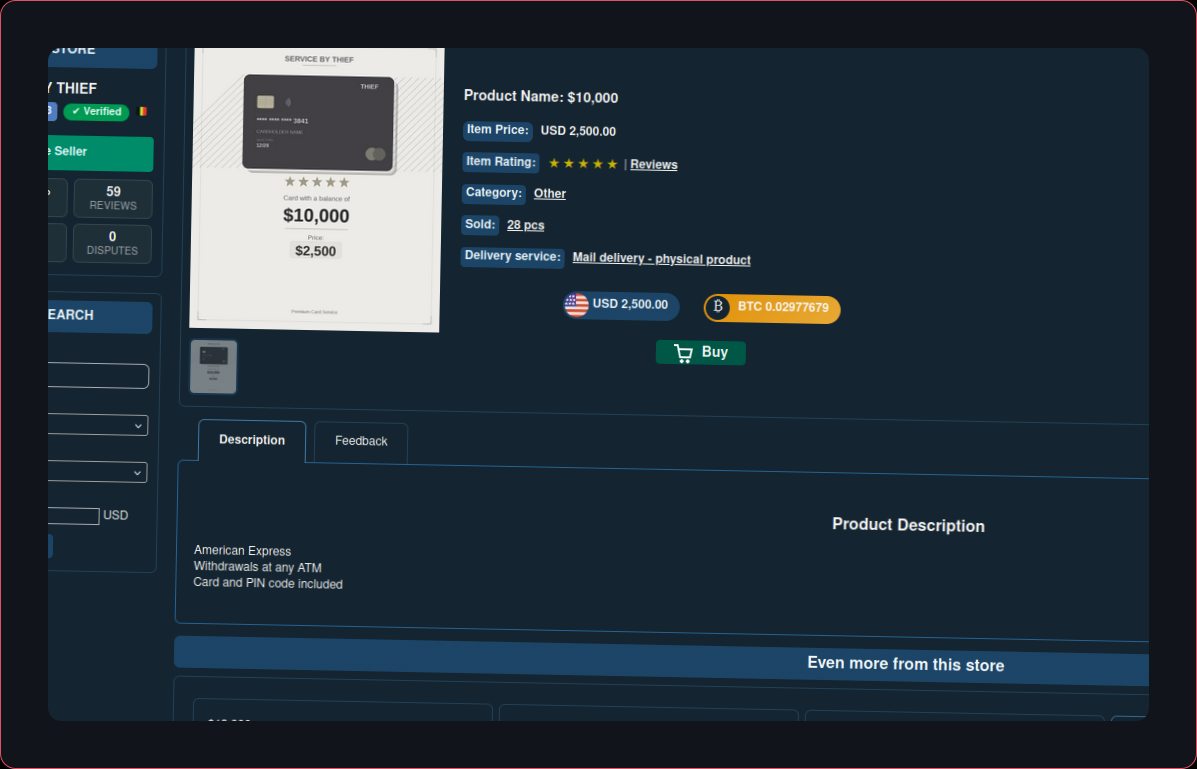
The online store offering illicit financial services and cloned card packages.
Trace the Investigation Timeline Across Fifteen Days
Financial institutions and law enforcement agencies adhere to specific protocols when notified of fraudulent behaviours occurring across multiple states. On Day 1, which is marked as November 2024, three individuals from Florida, Georgia, and North Carolina reported unauthorised cash withdrawals to their respective banks. This led to the immediate freezing of the affected cards by the financial institutions involved.
Progressing to Day 3, the bank's fraud detection mechanisms revealed a trend of questionable withdrawals linked to cloned cards that were functioning across state borders, prompting an internal inquiry.
By Day 5, the situation was escalated to the United States Secret Service, the governmental body tasked with investigating financial crimes. An analyst from this agency requested access to transaction records and pertinent video footage from the ATMs implicated in the incidents. On Day 8, footage from one of the ATMs captured a clear image of a suspect, which was subsequently matched against Mark T. in the driver's licence database held by Florida public safety officials; this check indicated no prior legal concerns.
On Day 12, investigators secured electronic warrants to scrutinise digital traces, which encompassed browsing histories and transaction records tied to cryptocurrency wallets. This investigation successfully traced a Monero transaction back to its original exchange via Tor exit nodes. Moving to Day 14, judicial consent allowed law enforcement to execute a search warrant at Mark's residence, where they seized six blank cards, a reading and writing device for magnetic stripes, a laptop indicating usage of the Tor Browser, $3,200 in cash, as well as the original shipping materials. Ultimately, on Day 15, authorities apprehended Mark, who, during interrogation, confessed to using four out of the six cards, while stating that the remaining two had already been rendered unusable as they had been blocked by the bank.
Examine the Financial and Physical Evidence
The investigation compiled specific metrics detailing the scope of the operation and the subsequent legal consequences. The total number of successful withdrawals reached 4, yielding an aggregate amount of $4,900 against the initial $480 investment for the cards. The duration between the final extraction and the physical arrest spanned precisely 15 days.
Examining the operational and financial figures provides a clear overview of the case.
Combined monetary penalties and repayment: $22,000
Completed cash withdrawals: 4
Cumulative extracted funds: $4,900
Elapsed days until apprehension: 15 days
Financial outlay: $480
Incarceration term in federal facility: 60 months
Post-confinement monitoring period: 3 years
Recovered physical currency: $3,200
Investigators established irrefutable links through physical items, such as the magnetic tracks found on the seized blanks matching the victim dumps. Furthermore, the $3,200 recovered from the residence matched the exact denomination breakdown dispensed by the targeted machines.
Mark bought the cards on a marketplace that we will not name, namely the website where the purchase was made, using Monero for payment.
Understand Why Cryptographic Anonymity Failed
Privacy-focused digital assets like Monero provide robust transaction obfuscation, yet the broader operational cycle contains mandatory entry and exit points. Mark utilized a centralized exchange to acquire the cryptocurrency, completing mandatory know-your-customer verification by uploading his official passport and a personal selfie. Court orders compelled the exchange to surrender this identity documentation and historical transaction ledgers.
While the internal movement of the asset remains difficult to follow, the temporal coincidence between the exchange purchase and the darknet marketplace payment established a definitive circumstantial link. No cryptographic protocol can cleanse physical evidence recovered during a residential search or erase a high-definition facial recording from a surveillance log. Security analysts emphasize that entry gateways into digital currency ecosystems remain vulnerable to legal compliance demands.
Review Operational Mistakes Made by the Perpetrator
Security assessments of this incident reveal multiple significant errors made by the individual in question. Initially, the four specific cash machines targeted for withdrawals were situated within a distance of 40 miles from his residence, which raised immediate geographical anomaly alerts in the banking security network. Furthermore, the decision to forgo facial coverings enabled automated systems to quickly recognise his identity through database matching processes. Additionally, using a KYC-compliant exchange to finance a purchase on an illicit marketplace severely undermined his efforts to maintain digital anonymity.
Moreover, the presence of physical tools, such as magnetic encoders and blank cards within the home, supplied tangible evidence to law enforcement. The possession of cash amounting to $3,200 in matching denominations further supported the conclusion regarding the illegal source of these funds. Lastly, executing all cash withdrawals over a span of two weeks significantly condensed the investigative timeframe; had these actions been distributed over a longer duration, it might have influenced the detection parameters, although surveillance cameras would have still identified him.
Analyze Lessons for Cybersecurity Professionals
Financial institutions rely heavily on automated anti-fraud mechanisms, scoring models, and behavioral pattern analysis as initial lines of defense before human analysts intervene. Integrating digital network logs with physical video evidence remains the cornerstone of modern financial crime investigations, as video footage alone lacks chronological context without transaction timestamps. Security experts stress that customer education regarding rapid reporting significantly diminishes potential financial losses.
Organizations developing card skimming protection mechanisms and card skimming protector hardware must continue refining automated anomaly detection algorithms. Understanding how to check for credit card skimmers or deploy a credit card skimmer protector remains vital for consumers, but stopping downstream buyers requires systemic cryptographic analysis combined with traditional surveillance frameworks.
The Federal Verdict and Legal Consequences
In March 2025, Mark T. acknowledged his wrongdoing regarding fraud related to access devices, as outlined in 18 U.S.C. § 1029, in addition to money laundering listed under 18 U.S.C. § 1957. The ruling from the U.S. District Court for the Middle District of Florida resulted in a prison term of 60 months. Upon completing his sentence, Mark will be subject to a supervised release period lasting three years. Furthermore, the court has mandated a financial penalty amounting to $22,000, alongside compensation for three designated victims.
During the sentencing hearing, the judge noted that Mark was the last link in the consumer chain, highlighting a significant concern: lower-tier criminals often face the most immediate consequences and legal actions. This uneven treatment remains a challenge for law enforcement agencies that seek to handle such cases effectively.
Questions readers ask
How long did it take for law enforcement to arrest Mark T. after his withdrawals?
Authorities arrested Mark T. exactly 15 days after the initial bank fraud alerts and subsequent investigations began.
What specific cryptocurrency did Mark use to buy the cloned cards?
He used Monero, selecting it specifically for its privacy features and resistance to blockchain transaction tracking.
What sentence did the federal court impose on Mark T.?
The court sentenced him to 60 months in federal prison, followed by three years of supervised release and $22,000 in restitution and fines.
How did investigators identify Mark T. from the ATM footage?
Investigators matched his unmasked face from the 1080p ATM surveillance video against the Florida Department of Public Safety driver database.